
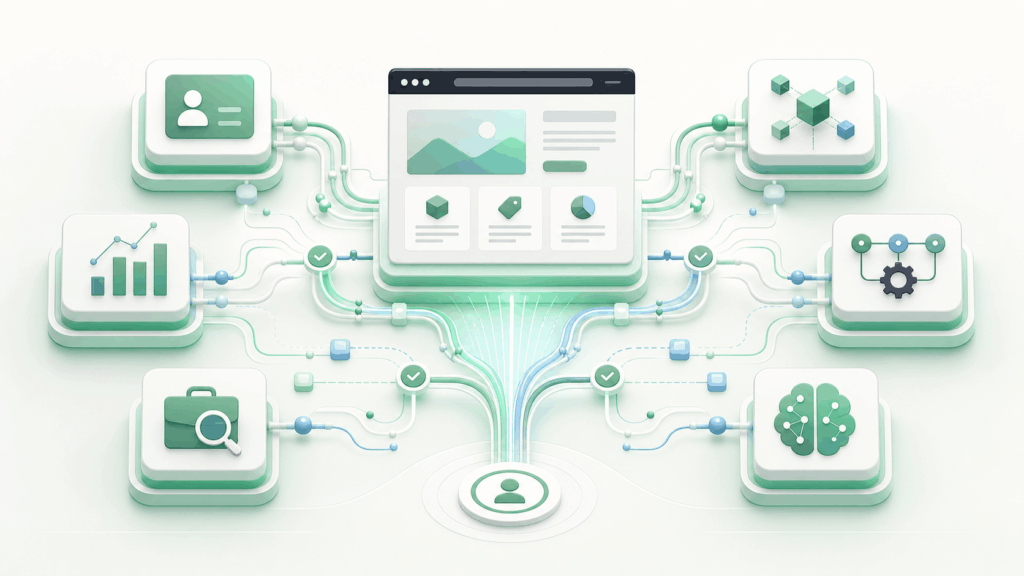

A modern business website is rarely only a website.
It may use WordPress as a flexible content management system, but the complete experience can also depend on CRM, analytics, consent, product data, search, recruitment platforms, automation, and AI-powered tools.
Some of those tools already exist. Others may be rebuilt, extended, or developed specifically for the business. Today, AI can make that custom development much faster.
But faster development does not automatically create a working system.
The more important challenge is making every part communicate correctly, behave consistently, and support one smooth experience for the customer, candidate, employee, or marketing team.
This is where the website becomes the integration layer – and where specialist knowledge matters most.
Building is faster. Integration is still the hard part.
It is now possible to prototype a calculator, search tool, assistant, configurator, or internal marketing application much faster than before.
That can include product or service advisors, smarter search and recommendation experiences, guided calculators and configurators, knowledge tools based on approved company information, and internal tools that prepare or classify information for human review. These solutions can live on the public website or inside the company.
That creates real opportunities. A business does not always need to wait for a large platform to add a missing feature. It may use an existing specialist tool, customize one, or build a focused solution around its exact process.
The difficult work begins when that solution has to become part of the business.
It may need to:
- receive accurate data from another platform;
- recognize the right customer, product, vacancy, or campaign;
- respect permissions and consent;
- update a CRM or internal system;
- appear naturally inside the website experience;
- give the marketing team appropriate control;
- continue working when a connected platform changes;
- produce reliable information for analytics and reporting.
The tool itself may be built quickly. Making it work correctly with everything around it is more complex.
What an integrated website system looks like
One candidate journey can involve an entire system
Consider a recruitment website.
The candidate sees one website, but their journey might involve:
- vacancies supplied by an external recruitment platform;
- WordPress content explaining the company and opportunities;
- filters and search interpreting live job data;
- an AI-assisted experience suggesting relevant positions;
- a form or application process collecting candidate information;
- verification, privacy, and consent requirements;
- analytics measuring whether candidates complete the journey;
- notifications or internal workflows for the recruitment team.
Every component can work separately while the complete journey still fails.
The search can display the wrong vacancy. The website and recruitment system can disagree about job details. An AI recommendation can be useful but point to data that is no longer current. An application can appear successful without reaching the expected workflow.
The candidate does not see separate systems. They experience one journey that either works smoothly or does not.
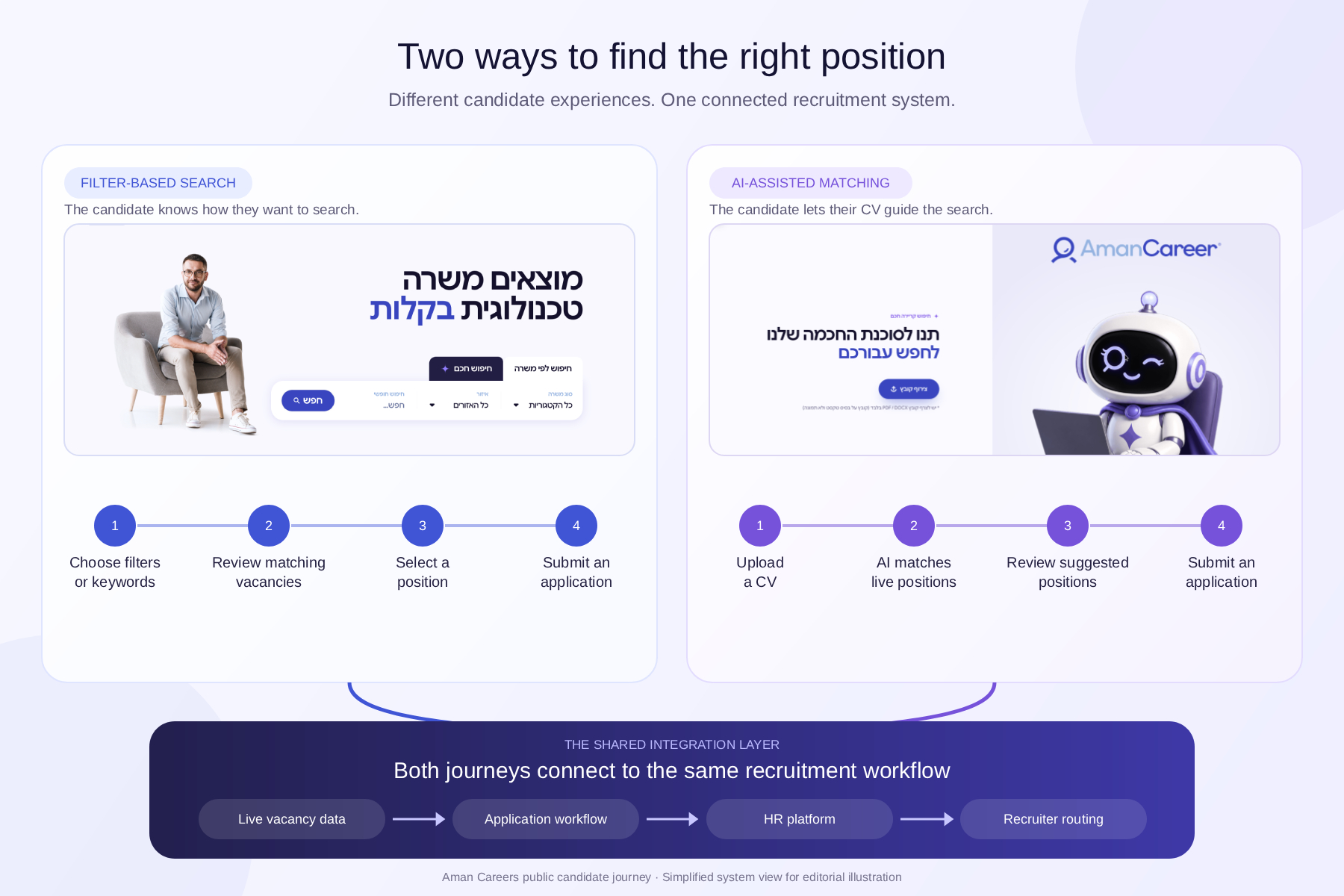
In recent AXE-WEB work, the Aman Careers website has required exactly this kind of thinking: connecting live job data, filter-based search, AI-assisted CV matching, application behaviour, and the recruitment system behind it. The visible interface is only one part of the delivery. The value comes from making the complete flow work together.
The same challenge appears across marketing websites
A product configurator may combine product rules, available options, dealer data, and live price calculations. It may be bought from a specialist provider, developed as a custom application, or rebuilt with a more modern approach.
Whichever path is chosen, the configurator still has to work with the website, product data, CRM, analytics, and follow-up process. A beautiful interface is not enough if it produces the wrong price or sends incomplete information to sales.
A B2B marketing website may connect campaign pages, forms, consent, analytics, lead identification, CRM, and automation. If a dashboard appears to be missing data, the visible website tag may not be the actual issue. The information may be passing through several properties, mappings, and external services.
An internal AI tool may help the marketing team search approved information, organize campaign inputs, prepare content, or classify enquiries. It may not appear on the public website at all, but it can still depend on website content, CRM data, permissions, and human approval.
These are different solutions, but the challenge is the same: many moving parts must behave like one system.
Integration requires knowledge across the complete journey
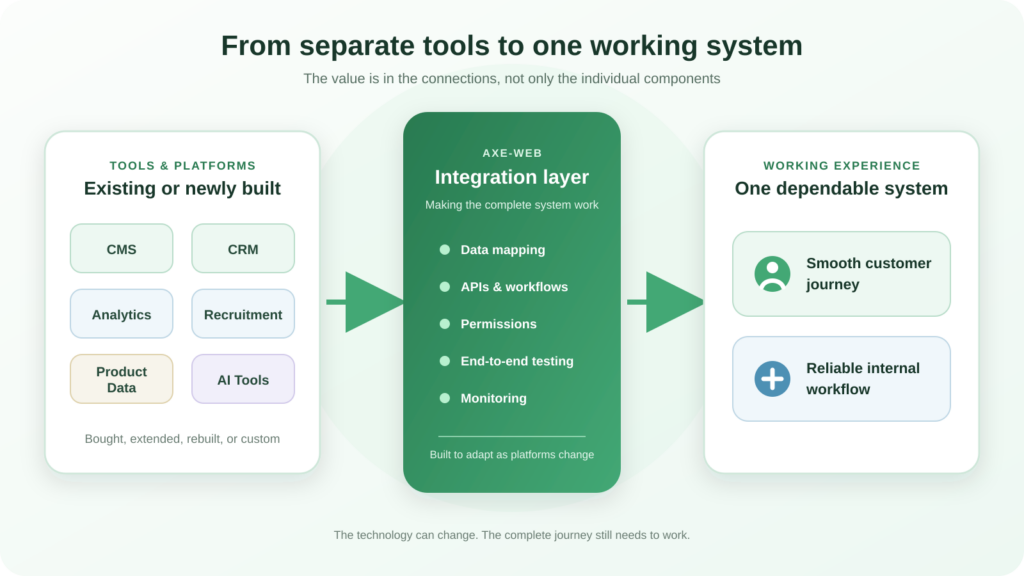
Connecting complex platforms is not only an API task.
It requires understanding:
- the business and marketing goal;
- what the visitor or internal user needs to accomplish;
- which system owns each piece of information;
- how data is structured and transferred;
- where security, privacy, consent, and permissions apply;
- how the interface should behave when data is incomplete or delayed;
- how editors can safely manage the content around the feature;
- how success is measured across several tools;
- how the system will be tested, monitored, and supported after launch.
This knowledge also has to remain current. APIs change. Platforms introduce new restrictions and capabilities. Analytics and privacy requirements evolve. AI services develop rapidly. A connection that worked several years ago may no longer be the best or safest approach today.
The integration layer needs both technical depth and an understanding of how marketing teams actually use the website.
When integrations stop working
How do you know you have an integration problem?
You may have an integration problem when:
- a form appears to submit successfully, but the lead does not reach the correct CRM or automation workflow;
- the website, CRM, and reports show different information;
- your team has to copy data manually between systems;
- changing one platform unexpectedly breaks another part of the customer journey;
- every supplier says its individual component works, but the complete process still fails.
Failures that happen only sometimes can also involve caching, hosting, or an external service rather than the integration itself. The first task is to identify which layer is actually failing and when.
How do you fix it?
Your team can start by checking the systems involved. Did the website send the information? Did the connected platform receive it? Did the next step in the workflow happen?
On a complex website, however, the problem often sits between systems. Finding it usually requires an experienced web developer or technical partner who understands WordPress, hosting, APIs, data, and the connected platforms.
AXE-WEB reproduces the problem, checks what should pass from one system to the next, and identifies whether the failure is in the website, an external platform, the hosting layer, or the connection between them. We then repair, rebuild, replace, or reconnect the failing part and test the real customer journey from beginning to end. Where appropriate, we add monitoring so the problem can be detected before customers report it.
You do not need to diagnose the technical layer by yourself. You need a partner who can take responsibility for the complete result—not only confirm that one component works.
What AXE-WEB brings to complex website systems
AXE-WEB does more than implement pages for your website.
We help marketing teams turn a business requirement into a connected technical solution. Depending on the project, that can mean using an existing platform, rebuilding a feature, developing a custom tool, or combining all three.
Our role can include:
- understanding the complete customer or internal workflow;
- defining and implementing how WordPress and external platforms should communicate;
- integrating CRM, analytics, consent, search, recruitment, product, event, and automation systems;
- developing custom WordPress functionality and focused external tools;
- using AI to accelerate useful solutions where it fits the requirement;
- connecting new features to real data and existing business processes;
- testing the complete journey rather than only the visible interface;
- maintaining and adapting integrations as platforms and requirements change.
The goal is to create the right system for the business and make every part of it work together smoothly.
Building individual tools is becoming faster. Creating a dependable integrated system is where the real expertise remains.
Whether you need to fix an existing integration, improve a customer journey, or add new website and AI capabilities, talk to AXE-WEB. We can develop, implement, and connect the technical solution so the complete system works reliably.