

Changing development partners can feel risky when the website is already central to marketing.
The site may support campaigns, forms, analytics, CRM workflows, multilingual content, third-party services, and years of custom development. The marketing team still needs to publish and launch while a new technical team learns how everything works.
The good news is that changing partners does not normally require rebuilding the website. It requires a coordinated handover: the new team receives the right access, understands the important parts of the current setup, avoids conflicts with the previous developers, and starts delivering without disrupting what already works.
When my team at AXE-WEB takes over an existing WordPress website, we do not begin with a long audit or stop the client from making changes. We learn the website while the work continues. The first releases may receive extra checks because we are confirming how the code, hosting, plugins, and integrations behave together. As that understanding grows, delivery becomes more routine.
Changing developers and rebuilding the website are separate decisions
Companies change development partners for many reasons. The business may have outgrown the current level of support. Marketing may need requests completed faster or more reliably. The original developer may no longer be available. The website may now require stronger WordPress, integration, or ongoing-development experience.
None of those reasons automatically means the website itself should be replaced.
A rebuild or major redesign should follow a marketing or business need: a rebrand, new messaging, a different user experience, new website logic, a major change in functionality, or a current website that genuinely cannot support what the company needs next.
If the website is still useful, a capable new development partner should be able to take responsibility for it, improve it, and support it over time—even if another team originally built it.
When does a rebuild make sense?
A partner change alone is not a reason to rebuild.
A rebuild or substantial website update may make sense when the business is changing its brand, messaging, design, user experience, content structure, functionality, or underlying logic. It may also be appropriate when the current website can no longer be maintained or extended reasonably.
That decision should be made because the website needs to change—not because a new development team needs to start from zero.
An experienced WordPress partner should be comfortable taking over what already exists, improving it where useful, and recommending larger changes only when they support the client’s actual plans.
What the client can prepare before changing development partners
The client does not need to produce a technical specification of the existing website. A short practical handover is more useful.
It helps to share:
- the most important current problems and requests;
- upcoming campaigns, launches, redesigns, or functionality changes;
- the website journeys and integrations the business relies on;
- the people who manage content or approve releases;
- the current developer’s contact details, if they are available;
- known hosting, domain, plugin, analytics, and third-party accounts;
- any existing documentation or design files that are still relevant.
Future plans are as important as current problems. A rebrand, new landing pages, integrations, languages, campaign journeys, design changes, new messaging, or user-experience work affect which parts of the website the new team should review first.
Missing information is normal. The new development partner should help discover what is needed while working through the transition.
What needs attention during the transition
The main transition risks are practical: two teams changing the same code, critical services remaining under the previous provider, or a website request depending on an outside system the new team cannot yet access.
Two development teams can overwrite each other’s code
If the previous and new teams both change a theme, plugin, configuration, or deployment at the same time, one release can overwrite or conflict with the other. Each change may be correct on its own; the problem is that neither team is working from the final version.
This is different from normal collaborative content editing. Marketing teams can usually continue updating pages, posts, and campaign copy. The coordination needs to focus on code and infrastructure changes: who is releasing them, from which version, and when responsibility moves to the new team.
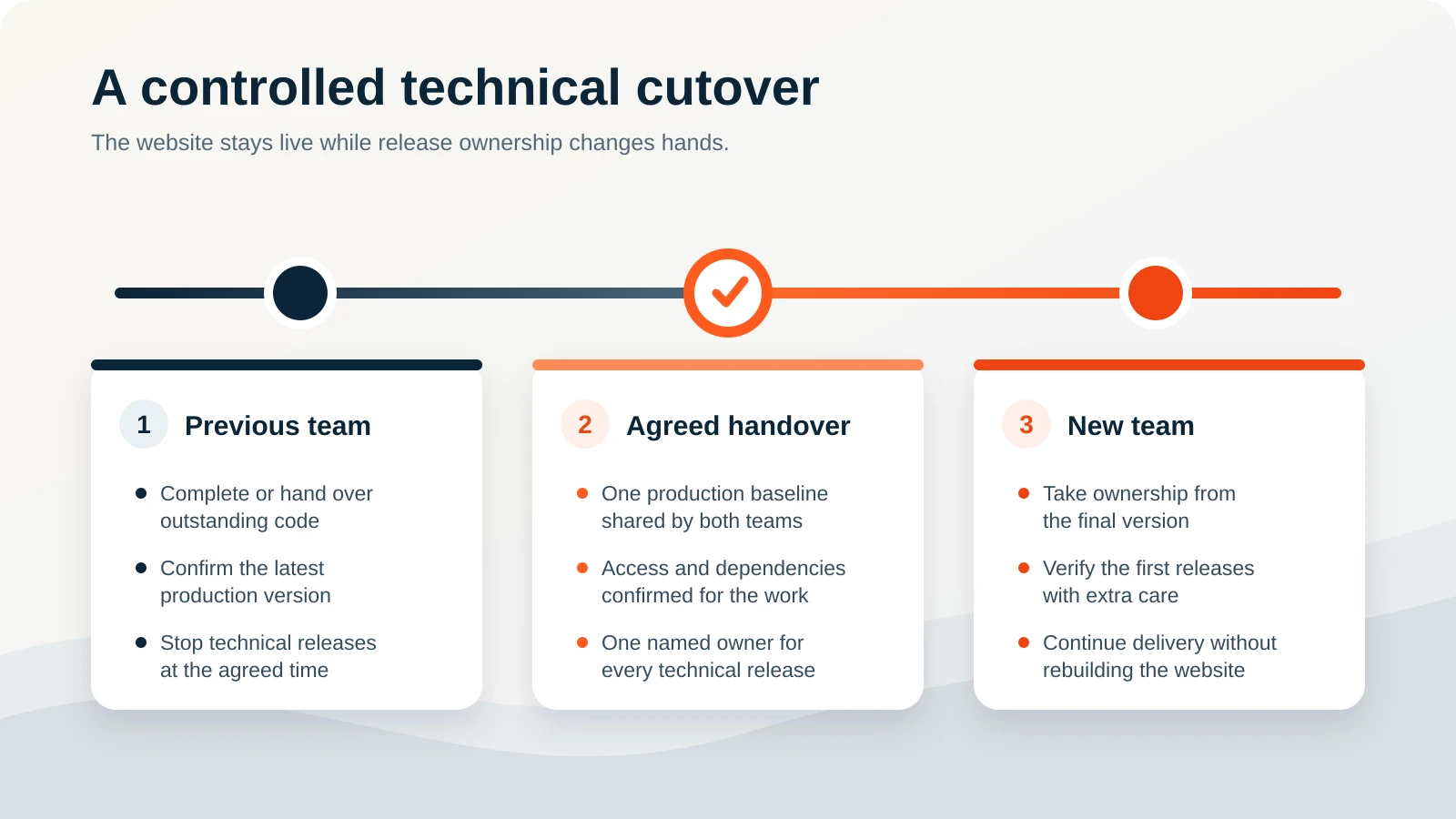
A practical cutover gives each team a clear point of responsibility. The previous developers finish or hand over their outstanding code, confirm the latest production version, and stop technical releases at an agreed time. The new team takes ownership from that version immediately afterwards. If both teams must remain involved briefly, each release and area of responsibility should have one named owner.
Critical services may still belong to the previous developer
Hosting, a paid plugin, a domain, DNS, or another third-party service may be owned or paid for by the previous development team. The website can continue working until a renewal, verification request, or support issue reveals that dependency.
During the transition, business-critical services should move either to the client or to the new development team, depending on the agreed support arrangement. If a less critical licence appears later through a renewal notification, the new team can review whether it is still needed and set up new ownership or billing before it expires. This is usually a practical account change, not a reason to delay the complete handover.
Missing access to another system can block a website request
During one recent anonymized handover, several website tasks depended on a third-party careers platform, tracking accounts, hosting, multilingual tools, and design assets held outside WordPress.
WordPress access alone was not enough to complete every request. Work connected to another platform required either access to that platform or coordination with the person who managed it.
We identified which launch tasks could proceed immediately, which ones needed external access, and who could provide it. That allowed marketing work to continue while the missing connections were handled in parallel.
A safe takeover does not freeze the website
Marketing work should continue during the transition. Content updates, campaign preparation, and routine requests do not normally need to stop.
The difference at the beginning is that technical changes may receive more investigation and verification. A request involving a form, integration, plugin, hosting configuration, or shared code deserves more care than a straightforward content update—especially while the new team is still checking how the pieces connect.
This can make some early development requests slightly slower. It should not become a long period in which nothing happens. The aim is to deliver useful work from the beginning, learn from each request, and reduce uncertainty without creating unnecessary process.
What AXE-WEB does during the first stage of a takeover
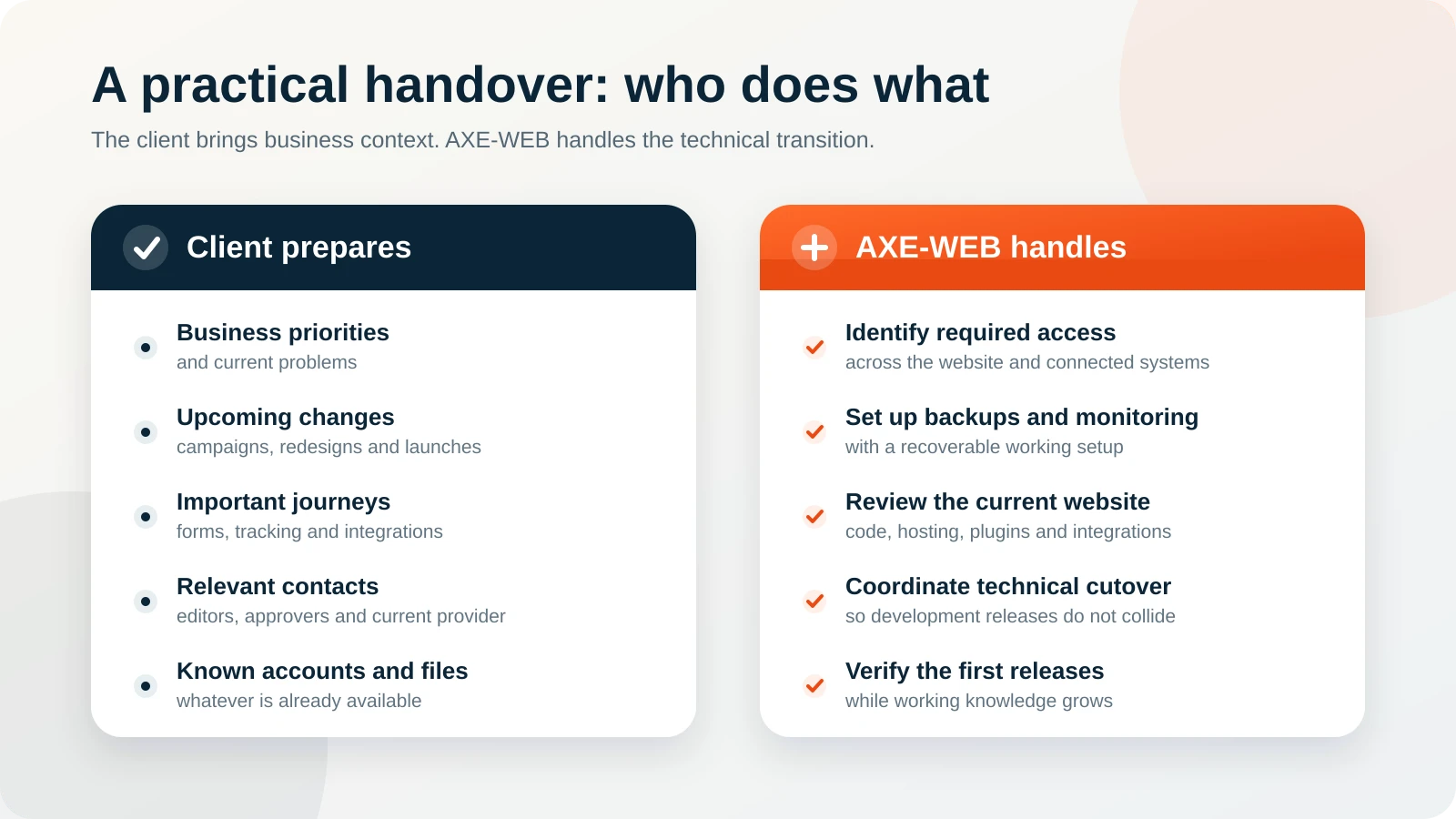
The marketing team provides business context, priorities, planned changes, relevant contacts, and the access it controls. The technical takeover work belongs to the new development partner.
For AXE-WEB, the first stage normally includes:
- Understanding current priorities and future plans. We establish what marketing needs now, what is coming next, and which website journeys or integrations matter most.
- Setting up the access required for the work. We identify the relevant WordPress, hosting, code, domain, analytics, and third-party accounts.
- Preparing a recoverable working setup. Our development team sets up and maintains backups and monitoring for every website we support, then prepares an appropriate development or staging workflow for technical changes.
- Reviewing the website around the client’s priorities. We review the website, code, configuration, plugins, hosting, and integrations, focusing first on the areas that concern the client now—such as SEO, speed, security, loading, or a planned feature—then expand that understanding as needed.
- Coordinating the technical cutover. If the previous team is still working, we clarify who is responsible for code and infrastructure releases so changes do not collide.
- Delivering and checking the first changes carefully. Early releases may take a little longer because we check for inherited dependencies and conflicts. This protects the website while our working knowledge grows.
This is an onboarding process, not a promise that every historical detail will be documented before development begins.
What a successful handover looks like
Website handovers are rarely complete. An old licence, forgotten integration, or unusual piece of code may surface later.
In my experience, what matters is how the new partner handles those discoveries: investigate the relevant area, explain the practical impact, protect current work, and keep delivery moving.
At AXE-WEB, we take over and support established WordPress websites, including sites with custom development and integrations. If you have outgrown your current development arrangement, we can help you change partners without rebuilding simply for the sake of changing teams.
Frequently asked questions
Usually not. Changing developers and rebuilding the website are separate decisions. Rebuild when the website, brand, user experience, functionality, or business requirements need a substantial change—not simply because a new team is taking responsibility.
Normally, no. Marketing and content work can continue. Code, infrastructure, and deployment changes should be coordinated if both development teams are active so one team does not overwrite the other’s work.
That is not how AXE-WEB normally approaches a takeover. We review the areas connected to the immediate priorities and continue learning the website through the work. Some early technical requests may take slightly longer because they receive additional conflict and dependency checks.
It depends on the work, but it may include access to WordPress, hosting, code repositories, domain or DNS management, analytics, tag management, and connected platforms. The new partner should identify what is necessary rather than asking the client to guess.
The client should generally control business-critical accounts and billing where practical, then invite the development partner with appropriate permissions. Some agency licences may remain part of a support agreement, but ownership, payment, and what happens after the agreement should be clear.
The website may continue working until the licence needs renewal or support. The new team should determine whether the plugin is still needed and whether it should move to the client’s billing, be covered under a new support agreement, or be replaced. Do not let an unknown renewal decide this at the last minute.
Yes, if responsibilities are clear. They should avoid releasing changes to the same code or infrastructure without coordination. A defined technical cutover date or change owner reduces conflicts while normal marketing work continues.
Share planned redesigns, rebranding, messaging changes, new languages, integrations, campaign launches, user-experience work, and functionality changes. Those plans help the team review the most relevant areas first and avoid short-term work that conflicts with an upcoming direction.
A takeover is still possible, but recovering access and understanding undocumented parts of the website may take longer. Begin with the accounts the client controls, identify missing ownership, and let the new technical team investigate the highest-priority areas first.
There is no single takeover period for every website. Routine work can often begin early, while understanding grows through the first requests. Timing depends on access, complexity, active development, integrations, and the changes the marketing team plans next.