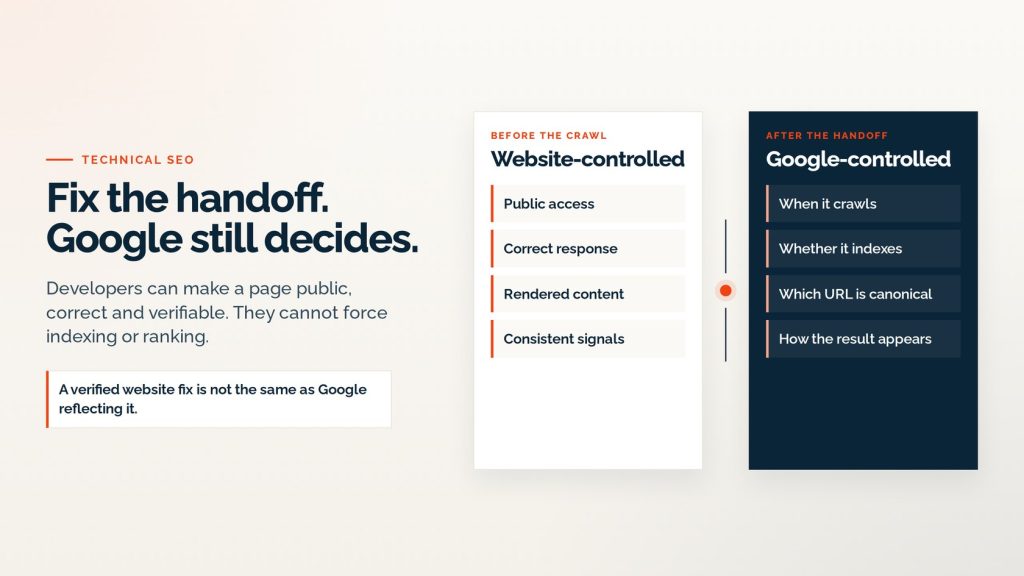

Google Search Console reports a problem. A page is excluded. A validation has failed. Google selected a different canonical. A server error appeared during crawling. The request that reaches the development team is often: “Can you fix Google?” Sometimes there is a clear website problem to fix. Sometimes the website is working correctly and Google has not processed the change yet. Sometimes an excluded URL should not be indexed at all. The useful first step is to separate what the website team controls from what Google decides. Technical SEO is the handoff between a website and a search engine. Developers can make that handoff clear, reliable and verifiable. They cannot force the receiving system to index, rank or display a page. That distinction is not an excuse to stop at “Google needs time.” It is a practical way to assign the right work, verify what changed and avoid promises nobody can keep. Treating every Search Console row as the same kind of failure has a practical cost. Development time goes to a URL that should stay out of search, or a launch is treated as unfinished because Google has not yet recrawled a page that is already correct. The earlier guide, GEO Without the Hype: Build Accessible, Indexable Pages First, covers the foundation: public pages, dependable content, clear structure, crawler choices and measurement for search and AI-assisted discovery. This article starts at the next question. Google is reporting a problem, and the development team is asked to fix it.
Crawling, indexing and ranking are different stages
These terms are often used as if they mean the same thing.
- Crawling means a search engine requests a URL and retrieves what the server returns.
- Rendering is the process of assembling the page, including content produced through JavaScript.
- Indexing means the search engine processes the page and may store it as a candidate for search results.
- Serving and ranking determine whether the page appears for a particular search, in which position and in what format.
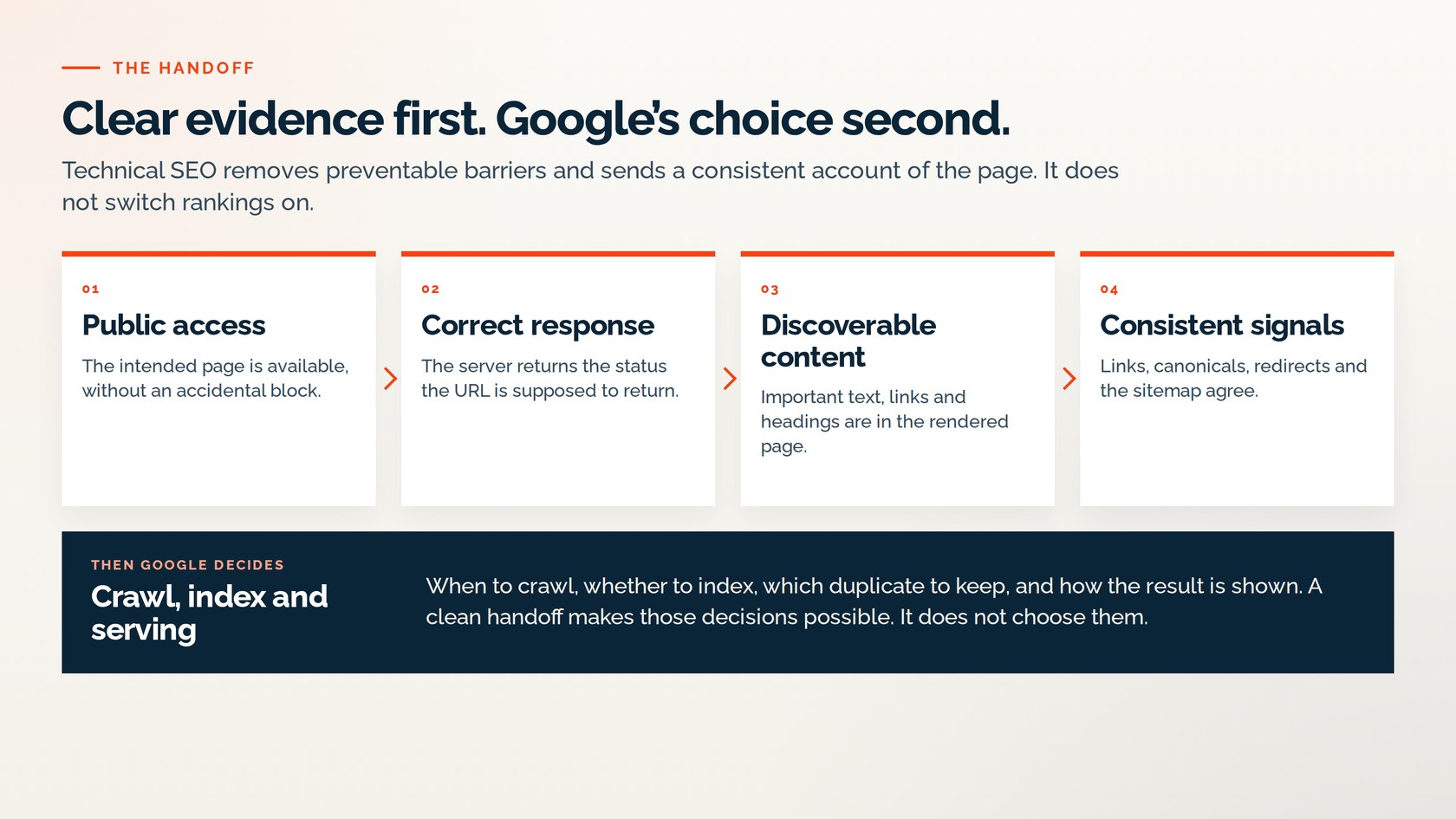
A page can be crawlable but not indexed. It can be indexed but not appear for the search a marketing team expects. It can rank while Google displays a different title or description. A valid fix at one stage does not guarantee an outcome at the next. Google's minimum technical requirements are straightforward: Googlebot must not be blocked, the page must return a successful response, and it must contain indexable content. Google also states that meeting those requirements does not guarantee indexing. The goal of technical SEO is therefore not to “switch rankings on.” It is to remove preventable barriers and send consistent evidence about what the website contains and which URLs should represent it.
What the website and development team can control
A marketing lead does not need to perform every check below. The useful part is knowing which questions belong with the development team, and which result still belongs to Google.
Public access and crawl controls
A developer can verify whether the intended public page is actually available to search crawlers. That includes checking:
- authentication and password protection;
- robots.txt rules;
- page-level
noindexdirectives; X-Robots-Tagresponse headers;- CDN, firewall and bot-protection rules;
- rate limits, CAPTCHA challenges and geographic restrictions;
- whether the same URL behaves differently for logged-in and logged-out visitors.
These controls are not interchangeable. A robots.txt rule controls crawling; a noindex directive controls indexing when the crawler can retrieve it. Blocking a crawler from a URL does not reliably remove an already known URL from search. The implementation must match the actual goal: public and indexable, public but excluded, or genuinely private.
Correct HTTP responses
Search engines learn from what the server returns, not from what the page was intended to return. A real public page should normally respond successfully. A permanently moved URL should use an appropriate permanent redirect. Removed content should return a genuine not-found or gone response rather than a visually empty page that still reports success. Persistent server errors and rate-limit responses can slow crawling and may eventually affect indexed URLs. A page that returns 200 while showing an error, an empty template or unrelated content can be interpreted as a soft 404. The development team can test the public response, logs and redirect chain, then correct the server, application, cache or CDN behavior that produces the wrong result.
Discovery through links and sitemaps
A page cannot depend only on somebody submitting its URL manually. Developers and content teams can ensure that important pages are connected through normal crawlable links, appear in the correct sitemap and are not stranded behind search forms, scripts or navigation that crawlers cannot use reliably. A sitemap is useful discovery information, not an instruction to index everything it contains. It should list the preferred canonical URLs and stay consistent with internal links, redirects and indexing rules.
Rendered content
Modern search engines can process JavaScript, but that does not make every implementation equally dependable. Important headings, copy, links, metadata and canonical information should be present in the rendered result a crawler receives. A script failure, delayed API response, blocked resource or client-only interaction can leave a crawler with a thin or empty page even while the page appears correct in one browser session. Developers can compare the original response, rendered HTML and public browser experience. Server-rendered or prerendered content can reduce unnecessary dependence on a crawler executing every script successfully, especially for central information and navigation.
Canonical consistency
Duplicate and near-duplicate URLs are normal. Tracking parameters, filters, print versions, migrated paths and multiple navigation routes can all expose similar content. A canonical annotation tells Google which URL the site prefers, but it is a signal—not a command. Redirects and canonical tags are stronger signals; sitemap inclusion is weaker. Google can still select the URL it considers the best representative. The website team can make the signals consistent:
- redirect obsolete URLs when a permanent move is intended;
- place the preferred canonical on the page;
- link internally to the preferred URL;
- include that URL in the sitemap;
- avoid contradictory canonicals, redirects and language annotations.
Search Console can then show both the declared canonical and Google's selected canonical, helping the team investigate disagreement rather than assuming the tag was ignored without reason.
Accurate structured data
Structured data can make visible page information more explicit and create eligibility for supported search features. It must describe what users can actually see and it must satisfy the requirements for the relevant type. Developers can implement, validate and keep structured data synchronized with the visible content. They cannot promise that Google will display a rich result, use the markup in a particular way or improve the page's ordinary ranking. Schema is a communication layer. It is not a ranking switch.
What Google still decides
Once the website provides a clean technical handoff, Google still controls:
- when and how often it crawls the URL;
- how much crawling it allocates to the site;
- whether the processed page is included in the index;
- which duplicate URL it selects as canonical;
- which searches the page is relevant to;
- the page's position for each search;
- the displayed title, snippet and search feature;
- whether structured data produces a rich result;
- whether the page is selected as a supporting link in an AI search experience.
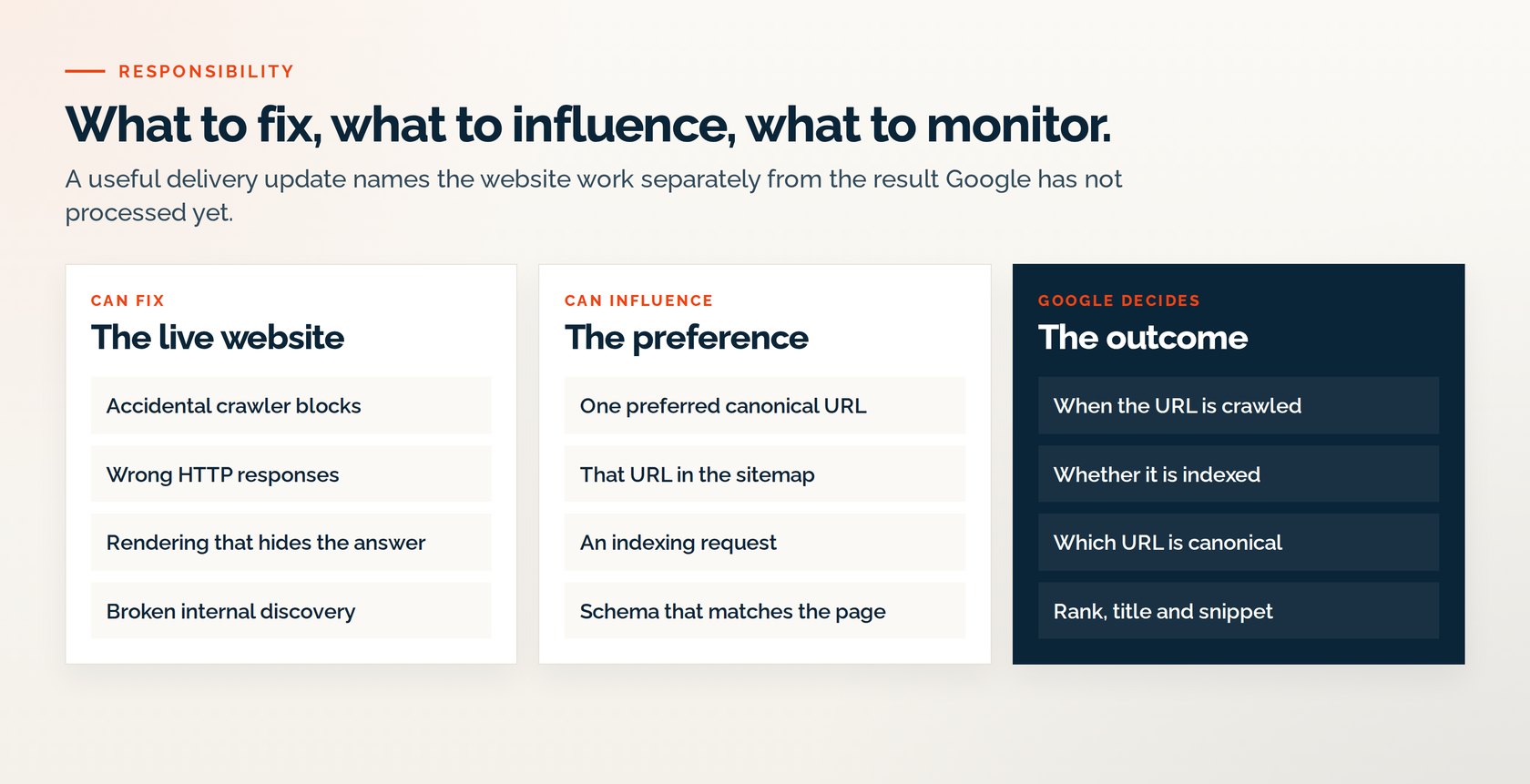
Submitting a sitemap, requesting indexing or starting validation can help Google discover or reconsider a change. It does not create a guaranteed processing time or outcome. This is why a useful status update to a marketing team distinguishes two statements:
- The live website issue has been corrected and verified.
- Google has recrawled and reflected the correction.
The first is often within the development team's control. The second must be monitored.
Not every excluded URL is an SEO problem
A healthy website can have many URLs that should not appear in search. Examples include:
- duplicate parameter and filter URLs;
- internal search results;
- private or account pages;
- obsolete URLs that redirect;
- intentionally removed content;
- staging, preview or test pages;
- alternate versions consolidated under a canonical URL.
The right question is not “How do we make every URL green in Search Console?” It is “Are the pages we want people to find accessible, indexable and represented by the correct canonical URLs?” Trying to force every discovered URL into the index can create duplication, expose private material and waste effort on pages that have no search purpose.
What a good technical SEO handoff should prove
When AXE-WEB investigates a technical search problem, the useful deliverable is evidence—not only a setting change. Depending on the issue, verification can include:
- the intended public URL and its final HTTP response;
- redirect-chain and server-error checks;
- robots.txt, meta robots and response-header directives;
- declared and search-selected canonicals;
- important source and rendered HTML content;
- internal-link and sitemap discovery;
- structured-data validity and alignment with visible content;
- Search Console Page Indexing or URL Inspection evidence;
- the date of the live correction and a reasonable recheck plan.
This makes responsibility visible. The marketing team can see what was wrong, what was changed, what has been verified and which result still depends on Google.
When a technical SEO problem is really development work
Many search problems cannot be solved inside an SEO plugin. A plugin cannot repair an overloaded server, a broken JavaScript render, an incorrect reverse-proxy response, a firewall blocking verified crawlers, a redirect loop, an inaccessible navigation system or a template emitting conflicting metadata across thousands of pages. Technical SEO becomes development work when the solution touches the website's architecture, templates, server behavior, deployment, integrations or content model. It also requires coordination. The SEO specialist may define the desired search outcome. The developer implements and verifies the website behavior. The content or brand team determines whether the page provides a useful and credible answer. Google makes the final crawl, index and serving decisions.
How AXE-WEB helps
AXE-WEB supports marketing teams at the website-controlled part of that chain. We can investigate crawling and indexing signals, correct server and application behavior, improve rendering and discovery, repair canonical and redirect conflicts, implement structured data, validate the public result and monitor what search platforms report afterward. This work fits naturally with our broader website development and technical support. Search visibility depends on the same website system as hosting, integrations, content publishing and ongoing development. Where the earlier question is whether important pages are public, understandable and ready for search and AI-assisted discovery, that foundation is in GEO Without the Hype: Build Accessible, Indexable Pages First. We will not promise a ranking, an indexation date or a citation. We will make the technical work explicit, test what can be tested and explain the remaining platform-controlled step.
Is Google reporting a technical problem with your website?
If important pages are excluded, returning errors, selecting the wrong canonical or losing search visibility after a launch or migration, AXE-WEB can help separate the website issue from the search-engine processing timeline.
Contact AXE-WEB to investigate the technical evidence, correct what the website controls and build a clear verification and monitoring plan.
Frequently asked questions
No. A developer can make the page public, crawlable, technically functional and indexable, connect it through internal links and sitemaps, and request indexing where appropriate. Google still decides whether and when to crawl and index the page.
Crawling is retrieving the URL. Indexing is processing and potentially storing the page as a search candidate. Ranking and serving determine whether it appears for a particular search and where. Success at one stage does not guarantee success at the next.
A successful response is only one requirement. The page may be a duplicate, contain little useful or indexable content, rely on rendering that failed for the crawler, conflict with canonical signals, be poorly connected internally, or simply not have been selected for indexing. URL Inspection and the Page Indexing report help narrow the cause.
No. A canonical annotation is a strong preference signal, but Google can select another representative URL. Redirects, canonicals, internal links and sitemap entries should consistently support the preferred URL, and Google's selected canonical should be checked in Search Console.
Google can render JavaScript, but scripts, resources and external APIs can fail or be delayed, and not every crawler executes JavaScript. Important content and links should survive the rendered response, and teams should test what the crawler actually receives rather than assuming a browser view is sufficient.
They communicate different conditions. A genuine 404 or 410 is appropriate for removed content. Persistent 500-series errors and rate limiting can reduce crawling and may eventually affect indexed URLs. The problem is an incorrect or prolonged response, not the mere existence of a valid not-found page.
No. Valid, visible-content-aligned structured data can make a page eligible for supported features. Google decides whether to display a rich result, and valid schema does not guarantee ranking or AI-search selection.
Check the public HTTP response, crawl and indexing directives, rendered content, canonical signals, internal links and sitemap. Search Console URL Inspection can show fetch, indexing and canonical information. Verification should record the live result separately from whether Google has recrawled it.