
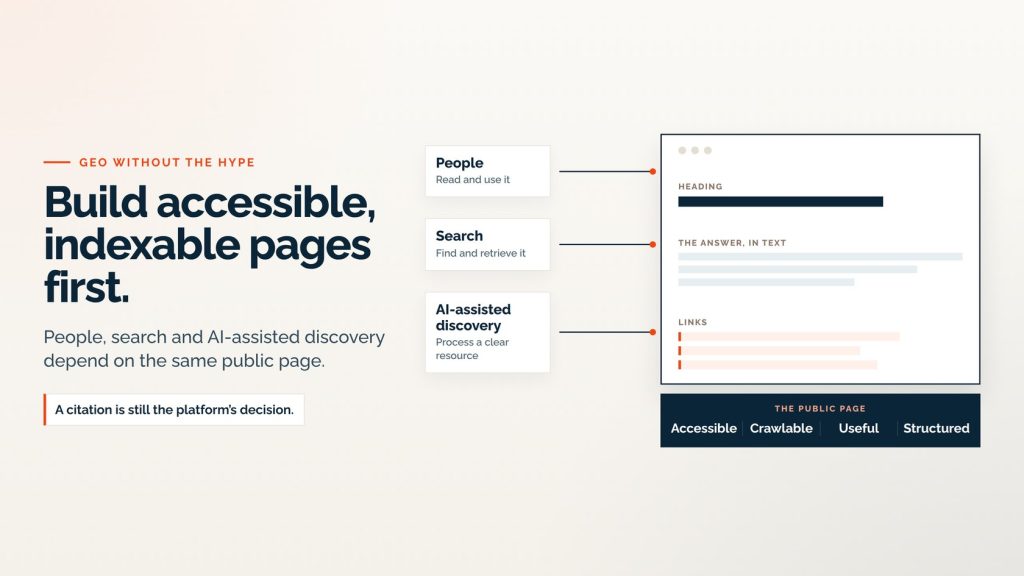

Generative engine optimization has quickly acquired the usual promises: a new schema will make AI understand your business, a special file will unlock visibility, or a checklist will make your company appear in AI answers.
The official guidance is less dramatic—and more useful.
Google says the same fundamentals that support conventional search also apply to its AI features. OpenAI and Microsoft publish their own crawler controls and discovery guidance. None of them offers a switch that guarantees a citation.
That does not make GEO meaningless. It means the durable work starts with a website that people and machines can access, navigate and understand: public pages, dependable responses, useful text, clear structure, consistent facts and sensible crawler controls.
What GEO can honestly mean
GEO is a useful label for improving the conditions under which content may be discovered, retrieved and used by AI-assisted search and answer systems.
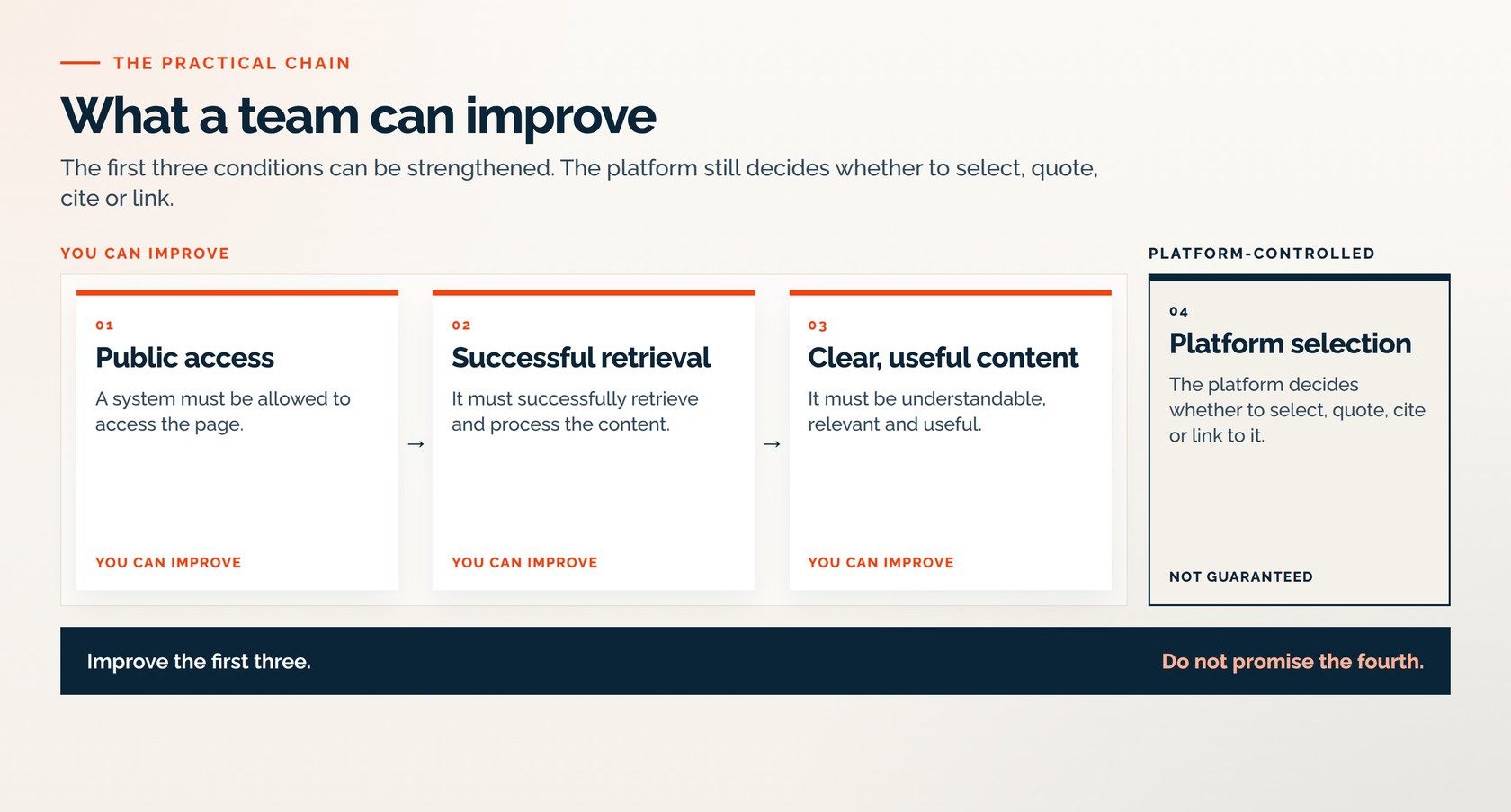
It is not a separate technical universe and it does not replace SEO. The practical chain still looks like this:
- A system must be allowed to access the page.
- It must successfully retrieve and process the content.
- The content must be understandable, relevant and useful for a particular question.
- The platform decides whether to select, quote, cite or link to it.
A team can improve the first three conditions. It cannot guarantee the fourth.
This distinction matters because “optimized for AI” is otherwise easy to sell and difficult to verify. A better GEO plan names the systems it is intended to support, the website changes involved and the evidence that will be measured.
Start with public, accessible web pages
A valuable answer hidden only inside a sales presentation, gated PDF, video player, image or private portal gives search and AI systems less dependable material to retrieve.
That does not mean every asset must disappear. A PDF can remain a convenient download. A video can remain the best way to demonstrate a process. The important knowledge can also exist as a useful HTML page, accurate transcript or supporting explanation.
The page should:
- be available at a stable public URL;
- return the correct HTTP response;
- work without authentication or an unnecessary form gate;
- contain the important answer as text in the rendered page;
- use descriptive headings and meaningful link text;
- be reachable through the site’s navigation or contextual internal links;
- remain usable with keyboard and assistive technologies;
- identify the organization, author, topic and update context clearly.
These are not tricks for AI. They are signs of a well-built web resource.
Make important content dependable in rendered HTML
Modern crawlers have different rendering capabilities. Google can process JavaScript, but rendering introduces additional steps and possible failure points. Other bots may execute less JavaScript or none at all.
If a page’s central answer appears only after a browser-side API call, interaction or script succeeds, the organization is making discovery unnecessarily fragile.
Server-rendered or pre-rendered HTML is not a universal requirement, but important headings, explanatory copy and links should be present in the rendered result that crawlers actually receive. Test the public response and rendered page instead of assuming that what appears in one browser is available to every system.
Use semantic structure, not an AI-only copy layer
Clear page structure helps visitors scan, assistive technologies navigate and machines interpret relationships.
Useful practices include:
- one descriptive page topic and a logical heading hierarchy;
- concise answers near the questions they address;
- lists, tables and definitions when they genuinely clarify information;
- descriptive link text and connected topic pages;
- accurate captions, transcripts and text alternatives for media;
- visible dates, authorship and source context where those details matter;
- consistent names, services, locations and product facts across the site.
The goal is not to write robotic fragments for a machine. It is to publish material that makes the subject and evidence clear without forcing a reader—or retrieval system—to reconstruct the answer from marketing language.
Original specificity matters more than content volume
AI-assisted discovery does not make mass-produced pages a durable strategy.
A strong page contains something worth retrieving: a clear explanation, first-hand process, useful comparison, original data, documented experience, practical example or authoritative source. It answers the user’s actual question and makes important limitations explicit.
Publishing hundreds of lightly varied “AI search” pages can create duplication and weak content without improving authority. A smaller library of specific, maintained resources is easier to trust, link and reuse.
For AXE-WEB, that means explaining how website systems work in practice: what a development team controls, how changes are verified, where platform decisions begin and what clients should expect next.
Structured data clarifies; it does not create authority
Schema markup can identify supported entities and relationships in a machine-readable form. It is useful when it accurately represents visible page content and follows the platform’s guidelines.
It does not tell an AI system what it must say. It does not guarantee a rich result, ranking or citation. Google also says no special schema or AI text file is required for its AI search features.
FAQ content can still be valuable when it answers real customer questions. FAQ rich-result visibility in Google is limited, however, so the business case should be the usefulness of the content—not the promise of extra search-result space.
Know which crawler you are controlling
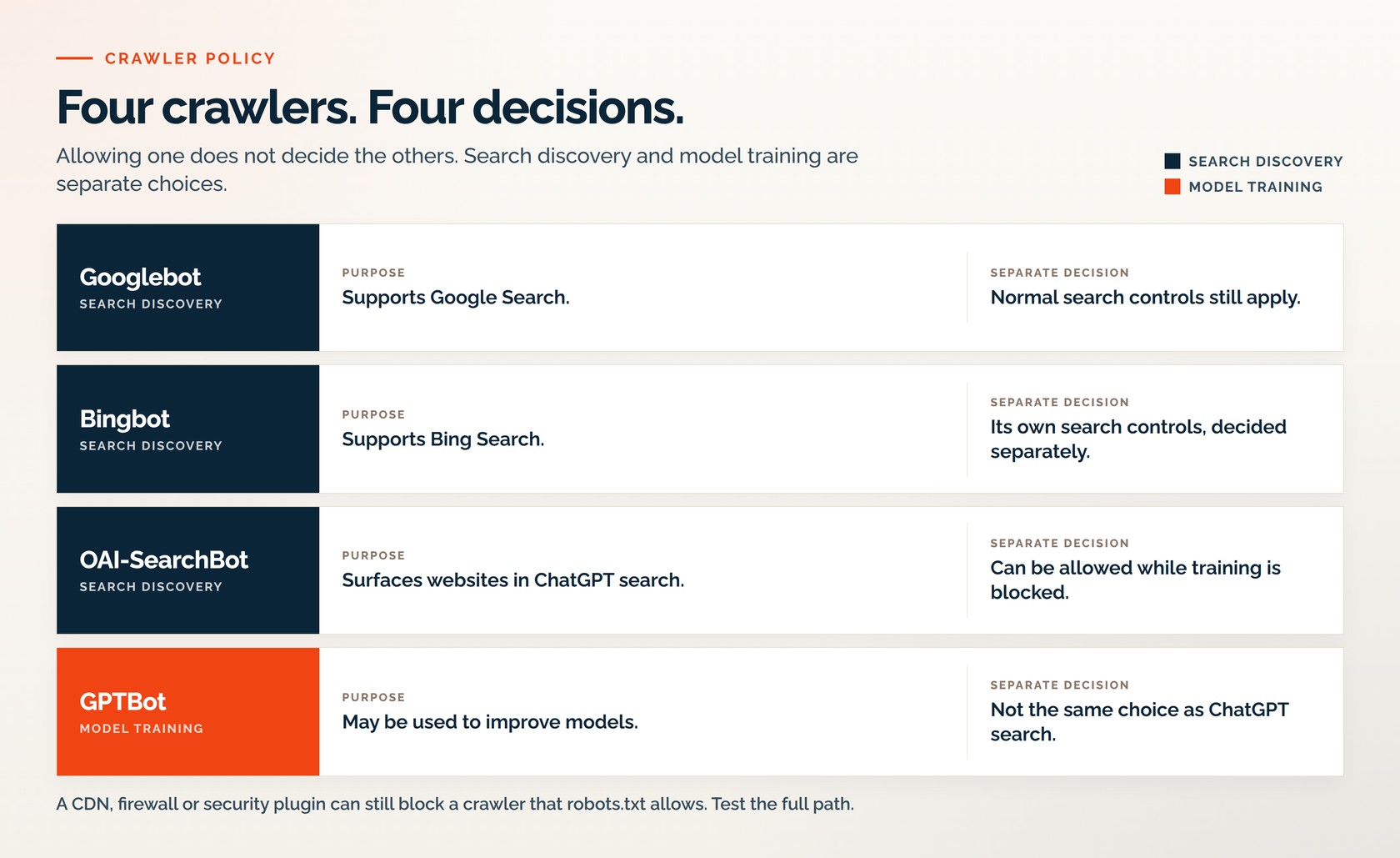
“Allow AI bots” is not a precise policy. Different crawlers serve different purposes, and crawler access is only one part of discovery.
Googlebot and Bingbot
These crawlers support their respective search systems. Normal search controls—robots.txt, page-level indexing directives, canonical signals, sitemaps, internal links and correct responses—remain relevant.
OAI-SearchBot
OpenAI identifies OAI-SearchBot as the crawler used to surface websites in ChatGPT search. A publisher can allow it even if the publisher makes a different decision about model-training access.
GPTBot
OpenAI identifies GPTBot separately for content that may be used to improve its generative AI models. Controlling GPTBot is not the same decision as controlling ChatGPT search discovery.
User-triggered agents
Some requests occur because a person explicitly asks a service to visit or retrieve a page. They may not behave like scheduled search crawlers, so policies should be based on the provider’s current documentation rather than a generic bot list.
A CDN, firewall or security plugin can block a legitimate crawler even when robots.txt allows it. Conversely, trusting a user-agent string alone is weak security because it can be copied. Teams should use the verification method published by the crawler provider and test the full delivery path.
Accessibility, SEO and GEO overlap – but are not the same outcome
An accessible page often has qualities that also support discovery: semantic headings, meaningful links, text alternatives, keyboard access and content that does not depend on one visual or interactive format.
That overlap is valuable, but accessibility should not be reduced to a ranking technique. A page can meet technical search requirements and still create serious barriers for people. It can also be accessible without earning a ranking or AI citation.
Treat accessibility as a user requirement, SEO as search discovery work and GEO as an additional discovery context. Good implementation can support all three without pretending one guarantees the others.
Avoid the GEO shortcuts that cannot be verified
Be cautious when a proposal depends on:
- guaranteed placement or citations in an AI answer;
- an “AI-only” schema vocabulary unsupported by the target platform;
- a special text file presented as mandatory for visibility;
- mass production of near-duplicate question pages;
- allowing every claimed AI crawler without deciding which uses are acceptable;
- counting crawler requests as proof that content was selected or trusted;
- adding FAQ markup solely to promise a search feature.
Some experimental files and emerging standards may become useful. They should be evaluated as experiments, not prerequisites, unless the target platform documents otherwise.
Measure what each platform actually exposes
There is no single GEO dashboard, and the available metrics should not be interpreted more strongly than their definitions allow.
- Google Search Console: Google says activity from its AI features is included in the Web search type. There is no clean filter that isolates every AI Overview or AI Mode interaction.
- Website analytics: OpenAI says ChatGPT search referral URLs include
utm_source=chatgpt.com, which can help identify attributable visits. Analytics should also measure whether those visits take useful actions. - Bing Webmaster Tools: Bing’s AI Performance reporting can show citations, cited pages and sampled queries. Citation counts do not reveal answer rank, placement, authority or sentiment.
- Server and CDN logs: Logs can confirm crawler requests and delivery failures. A crawl is evidence of access, not evidence of indexation or citation.
The most useful measurement plan combines platform evidence with business outcomes: qualified visits, enquiries, downloads, assisted conversions and the pages that helped people understand the offer.
A practical GEO foundation checklist
Before buying a separate GEO tool or producing AI-specific pages, check whether the website already does the fundamentals well:
- Important expertise exists on public, stable URLs.
- Pages return the intended response and are not accidentally blocked.
- Core content and links are present in dependable rendered HTML.
- Navigation and contextual internal links make resources discoverable.
- Headings, links, media alternatives and interaction patterns are accessible.
- Content provides original, specific and maintained answers.
- Organization, author, service and product facts are consistent.
- Structured data is supported, accurate and aligned with visible content.
- Crawler policies distinguish search discovery from training where possible.
- CDN and firewall behavior is tested, not inferred from robots.txt alone.
- Measurement definitions separate access, indexing, traffic, citations and conversions.
If these foundations are weak, an AI-visibility layer will not repair them. It may only add another dashboard to an unclear website system.
How AXE-WEB helps
AXE-WEB helps marketing teams turn valuable expertise into accessible, technically dependable website resources. We can audit crawler access, rendering, internal discovery, templates, structured data, security layers and analytics; convert gated or media-only knowledge into useful pages; and verify what the public website actually delivers.
This is part of our broader website development and technical support: improving the same web foundation that supports visitors, accessibility, conventional search and emerging AI-assisted discovery.
We will not promise an AI citation. We will make the website easier to access and understand, document the controls for the systems that matter, and build a measurement plan around evidence the platforms actually provide.
Is your website ready for search and AI-assisted discovery?
If valuable expertise is trapped in files, blocked by technical delivery or spread across pages that are difficult to understand and maintain, AXE-WEB can help build a stronger public content foundation.
Frequently asked questions
GEO focuses on discovery and selection in generative and AI-assisted experiences. In practice, it shares many foundations with SEO: accessible pages, successful crawling, useful content, clear structure and reliable technical delivery. It adds platform-specific crawler decisions and measurement, but it does not replace SEO.
No. Google’s guidance says no special schema or new machine-readable file is required for its AI features. Use supported structured data when it accurately represents visible content, and follow normal search technical requirements.
Semantic, accessible HTML can make content and relationships clearer to people, assistive technologies and machines. It improves the conditions for processing, but accessibility does not guarantee search rankings or AI citations.
Not every page must be server-rendered, but central copy, headings and links should be available in the rendered result crawlers receive. Server rendering or pre-rendering can reduce dependencies where JavaScript or external APIs otherwise make important content fragile.
OpenAI documents OAI-SearchBot for inclusion in ChatGPT search and GPTBot for content that may be used to improve generative AI models. They support different publisher choices and should not be treated as one permission.
OpenAI’s current documentation separates search and training crawlers, so a publisher can allow OAI-SearchBot while disallowing GPTBot. Policies should be reviewed against the latest documentation and tested at the CDN or firewall as well as in robots.txt.
No. Allowing access makes retrieval possible. The platform still decides whether to process, select, quote, cite or link to the page for a particular request.
Yes. Robots.txt expresses crawling preferences, but the request must still pass through DNS, hosting, CDN, firewall and application controls. Verify legitimate crawlers using the provider’s published method and test the returned response.
Use the evidence each system exposes: Google Search Console’s Web reporting, attributable referral traffic such as ChatGPT’s tagged URLs, Bing’s AI citation reports, server logs and on-site conversions. Keep crawling, indexing, visits, citations and business outcomes as separate metrics.