
For a few years the fashionable advice was to leave WordPress. It felt old. Projects had collected plugins nobody could explain. Webflow looked like the cleaner future, and tools like Lovable could put a first version on the screen in an afternoon.
I went back and looked at what actually happened. WordPress is still the platform the web runs on. In 2026 it also became the platform an AI tool can operate, from the computer you already use, without asking one vendor to add the feature. Webflow did not take that place. It has APIs. It has an MCP connection. It has adapters. It stopped being the future people were leaving for.
WordPress is still the platform
On 23 November 2026, W3Techs measured WordPress on 38.4% of all websites in its survey, and on 57.3% of websites whose CMS it could identify. Webflow was 0.8% of all websites and 1.2% of sites with a known CMS. Those are not neighboring products. One is the operating system of a large part of the web. The other is a hosted design tool with a real customer base and a small share.
Inside WordPress, the current generation is already the majority. The same W3Techs page says version 7 accounts for 70.7% of WordPress sites. Elementor is on 31.4% of them. The people, hosts, editors, and plugins required to keep a company site running are not a niche.
I will not pretend the line only goes up. WordPress’s share of all websites was about 43% at the start of 2026 and 38.4% on 23 November. Among sites with a known CMS, W3Techs shows WordPress moving from 60.5% on 1 November 2025 to 57.3% on 23 November 2026. Shopify and Wix gained in that same table. Webflow did not. Its share of known-CMS sites is 1.2% on every monthly row from November 2025 through 23 November 2026.
That is the market fact that matters. Some teams did leave tired WordPress projects. They did not leave for Webflow in any number this survey can see. The alternative that was supposed to replace WordPress stopped spreading.
Leading now means the AI work lives in the software
A chat window inside a builder is not leadership. Leadership is a website that can tell an outside assistant what it is allowed to do, can talk to more than one AI provider, and can learn a new action without the platform vendor shipping it.
WordPress has spent the last year putting that into the software itself.
The Abilities API has been part of WordPress core since version 6.9. An ability is a named action, such as creating a draft or reading a setting, with rules for who may run it. The site publishes a list. An assistant may use only that list.
On 20 May 2026 WordPress 7.0, named Armstrong, shipped the next piece. The official announcement calls it the foundation for AI across WordPress. An AI Client in core lets the site talk to generative models. Connections are managed from one place in the dashboard. WordPress does not pick the vendor for you. Plugins and themes call one interface, and the provider is a setting. The current maintained line is 7.1. WordPress.org lists 7.1.2 on 22 September 2026.
The third piece is the official MCP Adapter. It does not contain an AI model. It translates the abilities you choose to expose into the Model Context Protocol, the format Claude, Cursor, Codex, and other compatible tools already speak. You connect the tool from your own computer. The assistant still acts as a WordPress user. Abilities stay private until someone marks them public. On 23 September 2026 the adapter reached version 0.7.0, on the current protocol revisions. It remains a plugin on its own release cycle, which is the right place for a transport that has to keep up with the protocol.
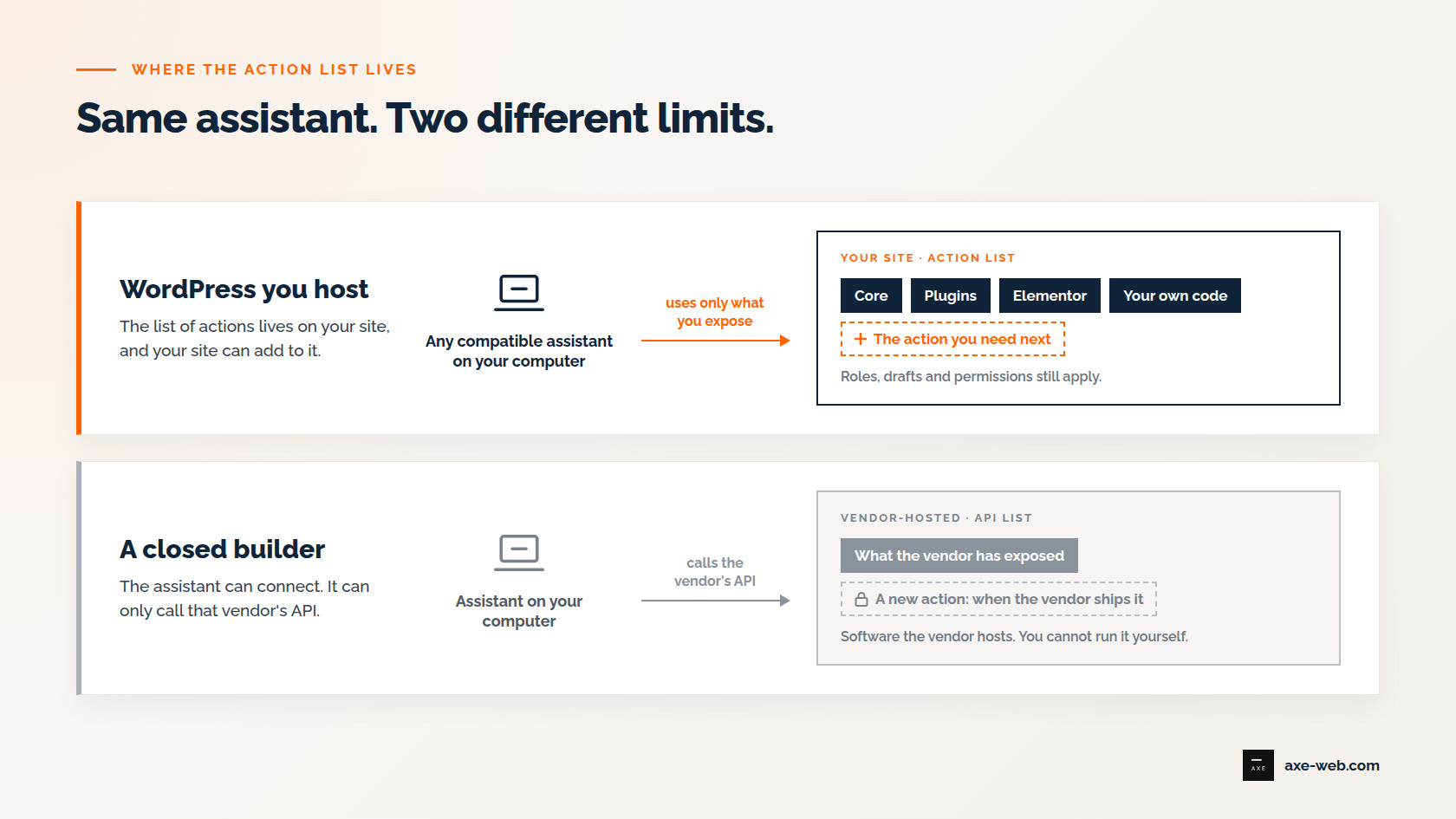
Because you host the software, the list does not stop where one company stopped. A plugin can register an ability. So can custom work built for that website. Elementor did exactly that. On 23 September 2026 it opened its own MCP connection, so the same kind of assistant can build native Elementor structure: pages, sections, and, where the setup allows it, theme parts and design-system styles. Elementor’s product page says the current path for existing layouts is Atomic, its newer element model. Classic widgets are on the “soon” list. The product page also says each generation lands as a draft. The help center adds that a tool can publish only inside the connected user’s role, through an application password you can revoke.
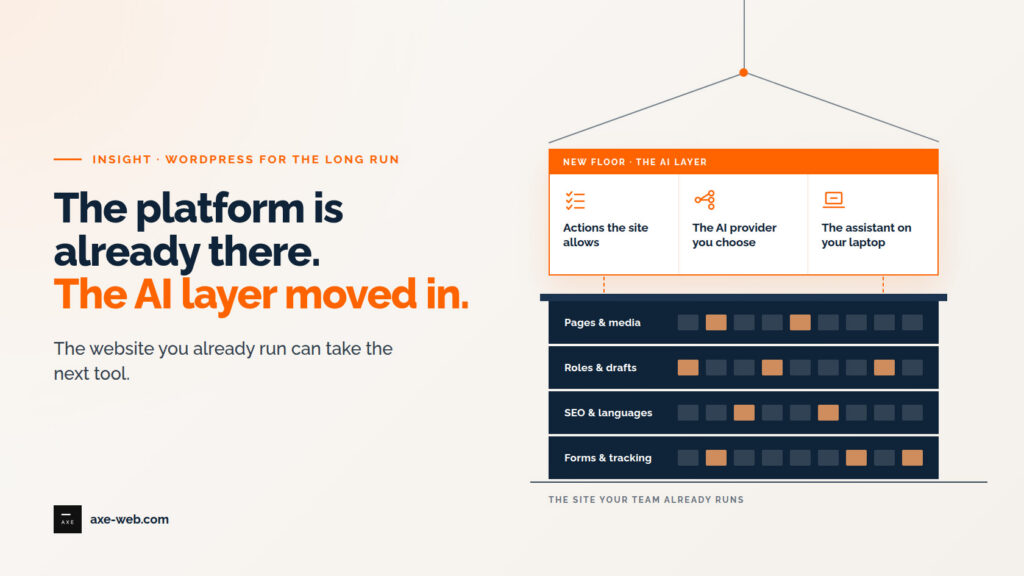
That combination is why I call WordPress the leading platform for the long run. The installed base was already there. The AI layer is now part of the same software, it is not tied to one model vendor, and any compatible assistant on your computer can use it. The next provider does not require a new website.
Installing WordPress does not turn this on by itself. Someone has to be on a current release, expose the actions that should be exposed, and choose the account the assistant uses. A neglected site does not become modern because the protocol exists.
Webflow did not become that platform
I am not saying Webflow has no API, no MCP, and no adapter. It has all three. Its help center, updated 21 September 2026, describes an MCP server that Claude, Cursor, Codex, and other compatible tools can use. Webflow is clear about what that server is. It translates the prompt into Webflow API calls and runs them on Webflow’s side. The assistant can do what that API currently exposes. Webflow says it cannot yet do every action in the product.
That is a closed platform with a modern connector. You may bring your own AI tool. You may not bring your own capabilities, and you may not host the software. When the action is not on Webflow’s list, the assistant stops.
The market has already treated it that way. Webflow grew for years, from a fraction of a percent to about 1.2% of sites with a known CMS. Then the line went flat, and it stayed flat for the twelve months in the W3Techs table I cited. A product can be well made and still not be where the web is going.
The company is acting like a product that has to narrow, not like a platform that is taking the category. On 27 May 2026, chief executive Linda Tong wrote that many teammates were leaving in a restructure. The stated destination is “the agentic web marketing platform.” She also wrote that Webflow is financially strong, and that AI tools and lighter builders are taking the simple sites Webflow once expected to serve. Webflow is concentrating on teams that want a deeper, hosted marketing system. In July 2024 the same executive had already cut about 8% of the company and described the business as healthy.
I will not call that a collapse. Webflow is still shipping, still taking customers, and still solvent on its own account. I will call the old story finished. Webflow was supposed to be the reason a serious company left WordPress. It is now a hosted product, with a connector to its own API, holding about one percent of the CMS market, and cutting staff to chase a narrower version of the same AI shift WordPress is building into the software you host.
Lovable, and generators like it, are a different dead end for this job. You can own and export the application code. You then operate the servers, database, sign-in, and security, and the generator’s editor does not come with you. That can be the right trade for a product. It is not a marketing website.
What you keep
- The software is not rented from one company. WordPress is GPL-licensed. You can run it, change it, and move it. WordPress.com is a different, hosted product. This recommendation is about the software you, or a partner, can host.
- The website is already the system of record. Pages, media, roles, drafts, forms, languages, and SEO stay where the marketing team already works. AI has to go through that system. It does not replace it with a second site.
- The AI layer is in the platform, not in one vendor’s chat box. Abilities in core, an AI client that can talk to the provider you choose, and an MCP adapter for the assistant already on your computer. WordPress 7.0 shipped the client on 20 May 2026. The adapter and Elementor are how an outside tool uses the site.
- You can change the AI provider without changing the website. Core does not bind you to one model. A different MCP client is a new connection, not a rebuild.
- The site can learn actions the platform did not ship. A plugin or custom work registers an ability. Elementor is the public proof that an editor can join the same list. The next integration can too.
- The assistant cannot outrank the account you give it. Permissions still apply. Elementor’s public path lands work as a draft. The connection is an application password. Turn the connection off and the website stays up.
- The surrounding craft already exists. Hosts, editors, commerce, multilingual tools, and people who know the platform are widely available. The W3Techs figures are a sign of that continuity. They are not a quality score, and they are not a claim that share is rising.
- The next campaign does not require a new platform. Brand, tracking, content, and the AI connection stay on the site you already run.
What this does not mean
A self-hosted site that nobody updates is not safer than a well-run hosted site. Plugins, access, backups, and performance still need an owner.
WordPress is not winning every job. Shopify and Wix gained share while WordPress eased down. A store that is the business, or a simple site nobody intends to extend, can be a different decision. I am writing about the company website a marketing team has to keep changing for years.
Elementor’s assistant does not redesign every existing page. Atomic layouts are the current path. Older widget layouts are not. Ask for a look at the templates before accepting a promise.
AI does not remove review. A draft can be wrong, off-brand, or missing the form and the tracking. Speed without that check is how a campaign page goes live half-finished.
Where AXE-WEB fits
We build and maintain WordPress websites. The reason we still recommend it is the reason in this article. It is the platform the web already runs on, and it is the platform now being built so the AI tool on your computer can work inside it. We connect that tool to the real site, limit it to the user and the actions that make sense, and leave a draft the team can open.
We will not recommend a move because a demo was faster. If a particular job belongs on a hosted builder or in a custom application, that should be said plainly. For the website that has to carry the brand, the campaigns, and the next AI tool after this one, we still recommend WordPress.
Frequently asked questions
On 23 November 2026 W3Techs measured WordPress on 38.4% of all websites and 57.3% of sites with a known CMS. Webflow was 0.8% and 1.2% on those same measures. WordPress’s share is lower than it was at the start of 2026. It is still the largest CMS in that survey by a wide margin. The newer lead is architectural. WordPress 6.9 put a registry of actions in core, WordPress 7.0 added a provider-agnostic AI client, and the official MCP Adapter lets an outside assistant use only the actions you expose.
Not in the W3Techs monthly table. From 1 November 2025 through 23 November 2026, Webflow stays at 1.2% of sites with a known CMS. WordPress falls from 60.5% to 57.3% in that table. Shopify and Wix are the products that gained. The “leave WordPress for Webflow” story is the one that stalled.
It is a real connector. Webflow’s help center, updated 21 September 2026, says compatible tools can design, edit, and manage content by calling Webflow’s API. The assistant can do what Webflow has exposed, on software Webflow hosts. You cannot add an action Webflow did not publish, and you cannot run the platform yourself. On WordPress the registry is in the site you host. Core, Elementor, other plugins, and your own code can add to it, and any MCP client on your computer can use what you turn on.
It cannot do more than the WordPress user it is using. Elementor’s product page says generated work lands as a draft until a person publishes it. Elementor’s editor guide also says a tool can publish when that user is allowed to publish. The safe setup is an account that cannot publish, a human review, and an application password you can revoke.
Not automatically. Elementor says current MCP editing of existing layouts supports Atomic layouts. Older widget layouts are planned, not currently supported. Ask for a look at the actual templates first.
No. WordPress.com is a hosted service. The recommendation here is the open-source software you can host, or have a partner host, currently on the 7.1 line.
No. The point is to add a controlled connection to the site you already run. You need a current WordPress release, a decision about which actions are exposed, and a user role that matches the risk. Some Elementor work also needs a current Elementor version and a realistic limit on older layouts. None of that is a new website.
Sources
- W3Techs WordPress, 23 November 2026: https:/
/ w3techs.com/ technologies/ details/ cm- wordpress - W3Techs Webflow, September 2026: https:/
/ w3techs.com/ technologies/ details/ cm- webflow - W3Techs CMS history, monthly through 23 November 2026: https:/
/ w3techs.com/ technologies/ history_overview/ content_management - WordPress 7.0 announcement, 20 May 2026: https:/
/ wordpress.org/ news/ 2026/ 05/ armstrong/ - AI Client in 7.0: https:/
/ make.wordpress.org/ core/ 2026/ 03/ 24/ introducing- the- ai- client- in- wordpress- 7- 0/ - WordPress 7.0 field guide: https:/
/ make.wordpress.org/ core/ 2026/ 05/ 14/ wordpress- 7- 0- field- guide/ - Release archive, 7.1.2 on 22 September 2026: https:/
/ wordpress.org/ download/ releases/ - Abilities API: https:/
/ developer.wordpress.org/ apis/ abilities- api/ - MCP Adapter readme, 0.7.0 on 23 September 2026: https:/
/ github.com/ WordPress/ mcp- adapter/ blob/ trunk/ readme.txt - Elementor MCP: https:/
/ elementor.com/ mcp/ - Elementor connection help: https:/
/ elementor.com/ help/ how- to- connect- elementor- to- an- ai- tool- using- mcp/ - Webflow MCP overview, updated 21 September 2026: https:/
/ help.webflow.com/ hc/ en- us/ articles/ 52536562285203- Webflow- MCP- server- overview - Webflow MCP developer overview: https:/
/ developers.webflow.com/ mcp/ reference/ overview - Webflow CEO, 27 May 2026: https:/
/ webflow.com/ blog/ evolving- webflow- for- the- agentic- web - Webflow CEO, 24 October 2025: https:/
/ webflow.com/ blog/ restructuring- announcement